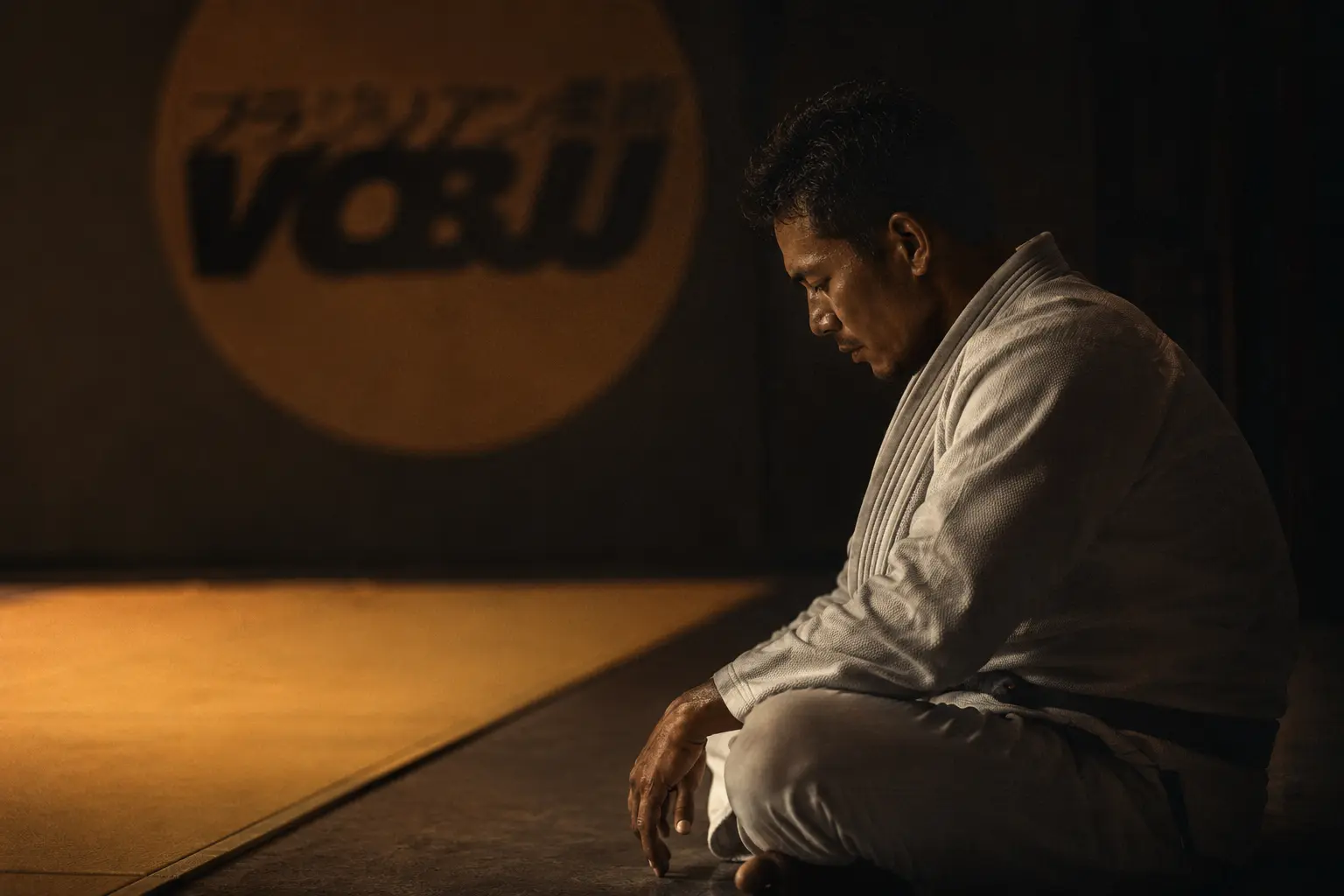
After rolling, there is a period that other sports don’t quite replicate. Maybe forty minutes. Sometimes longer. The mental noise that follows you from the office, the calendar, the family WhatsApp group — it goes quiet. Not because you solved anything. Because your brain was too occupied to let it in.
People call it the grappler’s high. I understand why they reach for that word, but I don’t think it fully captures what happens. Runner’s high is about distance covered, the rhythm of a body in motion, endorphins doing their work. What you get from BJJ is different. It’s not euphoria. It’s something quieter. More like the moment after a very hard problem gets solved — except you didn’t solve it with your mind.
Rolling demands your full attention. Not the kind of attention you bring to a meeting where you can half-listen and still follow along. Every single exchange on the mat requires you to read what’s happening, respond in real time, and recalibrate when it doesn’t work. There is no background processing. The thing you were worried about on the drive over — the deal, the conversation you need to have, the numbers that don’t add up — it gets displaced. Not suppressed. Displaced. Your nervous system had to spend that capacity somewhere else.
I’ve been training since 2002 and coaching for a long time before that. The students who stay are rarely the ones who came for fitness. They came for the physical thing — to get in shape, to lose weight, to have something to point to on the calendar. Those are legitimate reasons to start. They are almost never the reasons people are still training five years later.
The ones who stay describe something they didn’t expect. A session two or three months in where they drove home and noticed they weren’t rehearsing arguments or running through tomorrow’s problem list. They were just driving. And the absence of that background noise felt strange at first, then something closer to relief.
This is what I mean when I say BJJ gives you complete presence enforced. Not meditated presence, not performed presence — the kind you manufacture by closing your laptop and trying to focus. Enforced. Because if your mind wanders, your training partner is going to be on top of you before you noticed it left.
The absence of mental noise, when it arrives, feels like finding a room in your own house you didn’t know was there.
There is a real physiological story here. Grappling is problem-solving under physical stress. Each position you’re put in is a spatial puzzle with a time limit. Your brain runs hot processing this. Heart rate climbs, cortisol rises during the round, and then — when the session ends — there is a clear-out. The stress hormones come down. Endorphins do their work. But the specificity of what BJJ demands of your attention means the effect is more pronounced than general exercise. You weren’t just moving your body. You were fully occupied. The recovery from that kind of occupation is deeper.
Most of the people I teach are professionals in their 40s and 50s. Busy in the way that specific decade of life is busy — professionally, domestically, quietly. Not complaining about it, just carrying it. The question they were actually asking when they looked at the website wasn’t “will I get fit?” It was something harder to phrase. Something closer to: is there still a thing I can learn with my body that will matter?
The grappler’s high is not a marketing point. It’s a side effect. You can’t go looking for it — it arrives when you stop thinking and start reacting. But once it’s happened a few times, it becomes the real reason people come back.
What they come back for is that hour. The one where nothing else competes.