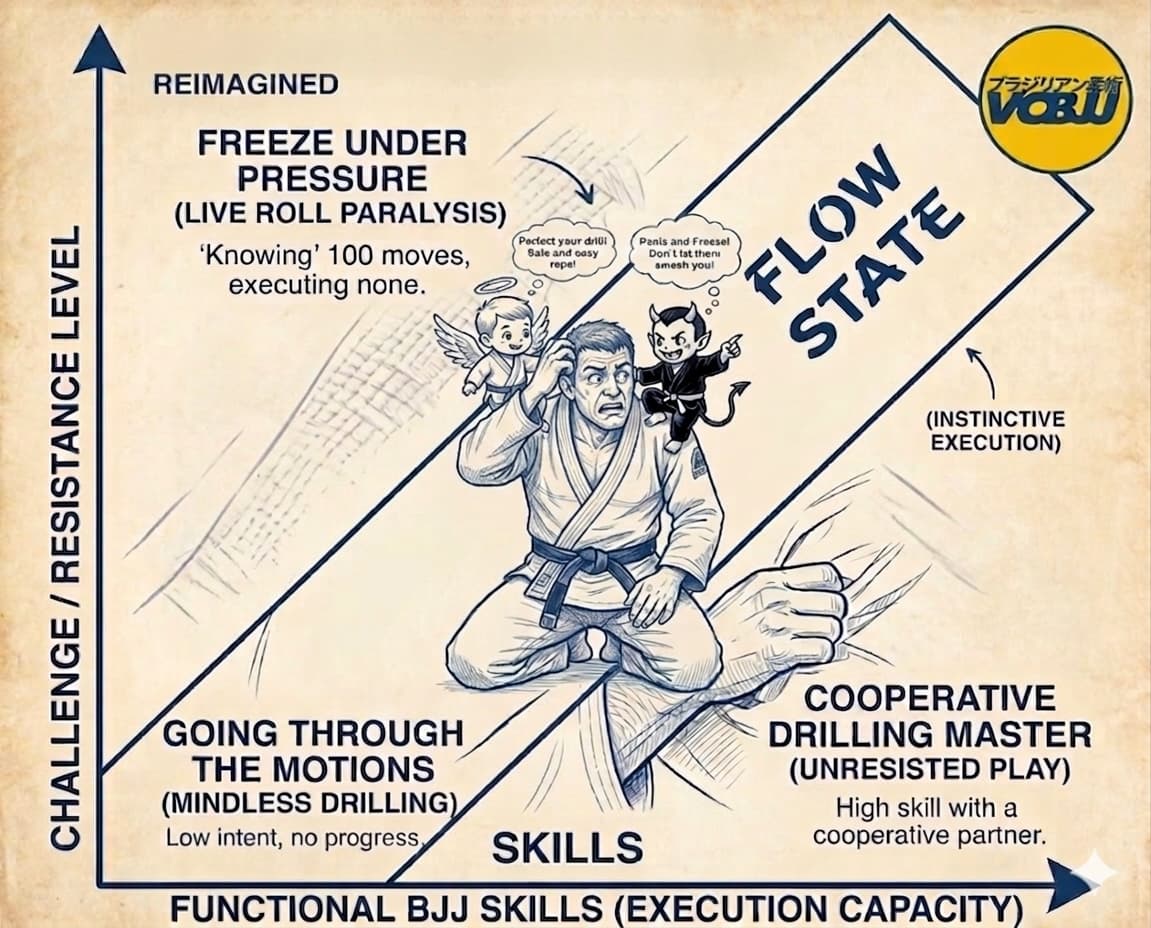
Have you ever felt like a BJJ genius when you're watching videos or drilling, but then feel like a total beginner the moment someone actually tries to smash you?
You're not alone. It's one of the most common things I see in adult practitioners — especially those who come in analytically, which is most of the people who train here. Your head knows the moves. Your body hasn't learned to use them under pressure yet. There's a reason for that, and once you understand it, you can actually do something about it.
The Two Lines That Matter
Think of your training as a graph with two variables that need to stay in balance:
- Skill — not knowing the name of a technique, but being able to execute it while someone is actively moving against you.
- Challenge — how hard your partner is resisting, the pace of the round, the unfamiliarity of the position.
When these two track together, something good happens. When they diverge, you end up in one of two problem zones.
The Anxiety Zone and the Boredom Zone
The Anxiety Zone is where challenge runs well ahead of skill. Your brain doesn't freeze because you're weak or unprepared — it freezes because it's genuinely overwhelmed. The nervous system reads the situation as a threat it doesn't have a response for, and it defaults to the most primitive options: tense up, hold on, wait for it to stop. You've probably felt this. Everyone has.
The Boredom Zone is the other failure mode, and it's more insidious because it feels like progress. You drill the same moves with no resistance, you get clean reps, you feel competent. But you're building a version of the technique that only works in a controlled environment. The live version — the one with a moving, thinking, resisting person on the other end — is a different problem entirely. The Boredom Zone produces knowledge without transferable skill.
The Flow State: Where Real Learning Happens
Between the two zones is a band where challenge and skill are roughly matched — where you're stretched just enough to stay focused but not so far that you panic. This is the Flow State. It's not a mystical concept. It's just the conditions under which your nervous system is alert, engaged, and able to process new information.
The goal of good training design is to keep you in that band as much as possible.
A Simple Game Plan
If you have knowledge but struggle to apply it under pressure, there are three things worth focusing on — in this order:
Build your foundation first. Before adding more techniques, invest in the structural basics — your posture, base, and mobility. When your body is in the right position, the techniques you already know start to work more reliably. A lot of students are not short on knowledge. They're short on the physical foundations that let the knowledge express itself.
Turn down the heat deliberately. Don't jump into full-intensity rounds expecting the reps to sort themselves out. Use positional sparring at lower resistance — start from a specific position, work one objective, keep the intensity manageable. This is how you build the live version of a technique. The challenge gradually rises as the skill catches up.
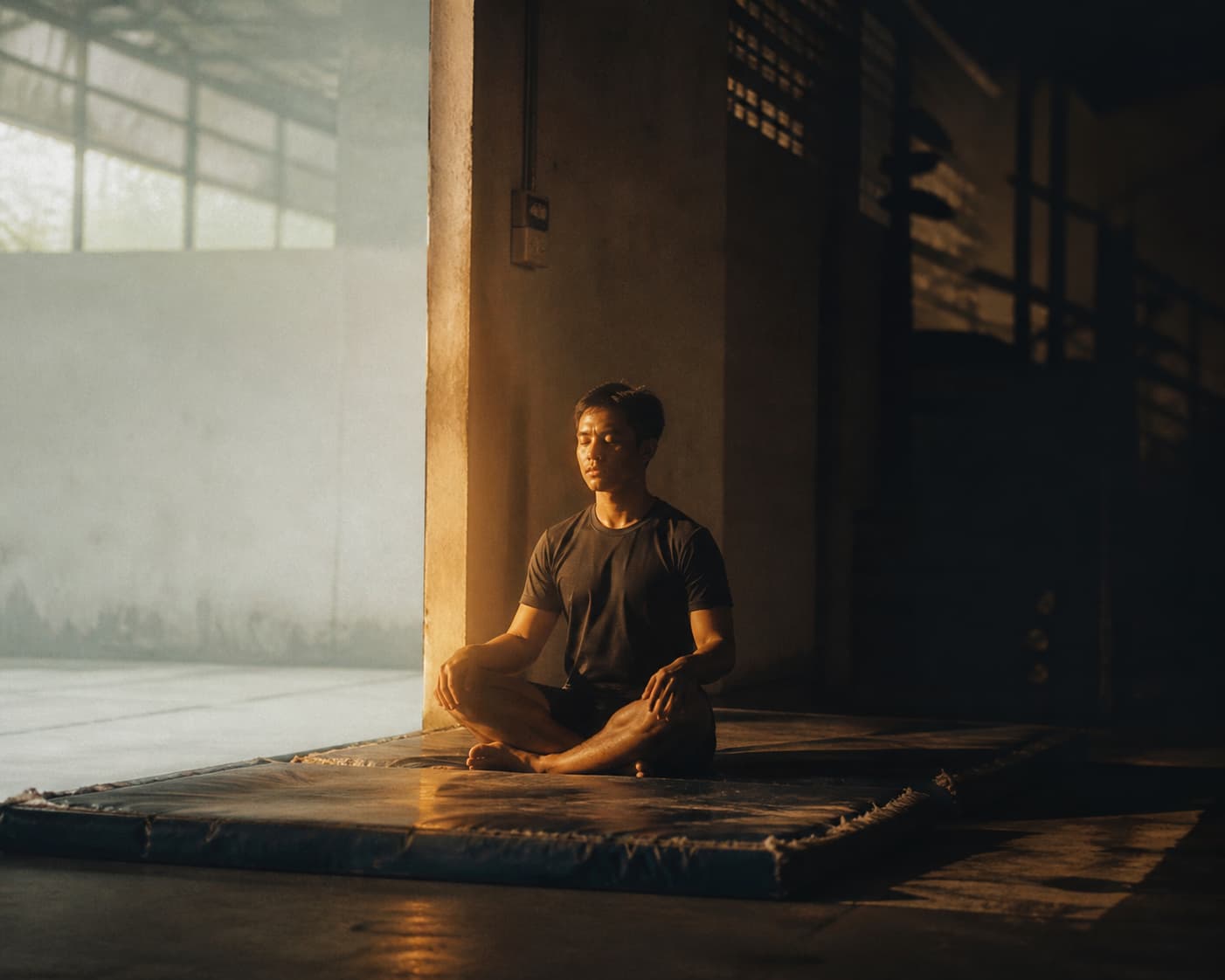
Learn to reset your nervous system. When anxiety takes over, the first thing to go is your breathing. Diaphragmatic breathing — slow, deliberate exhales — activates the parasympathetic response and quiets the alarm. A physiological sigh (double inhale through the nose, long exhale through the mouth) is faster still. These aren't tricks. They're the mechanism by which you stay in the problem-solving part of your brain rather than the survival part.
None of this is complicated. But it requires being honest about which zone you're usually in — and being willing to train below your ego for a while to build something that actually transfers.
Keep it sustainable. Focus on your structure. The execution will follow.
— Vince